


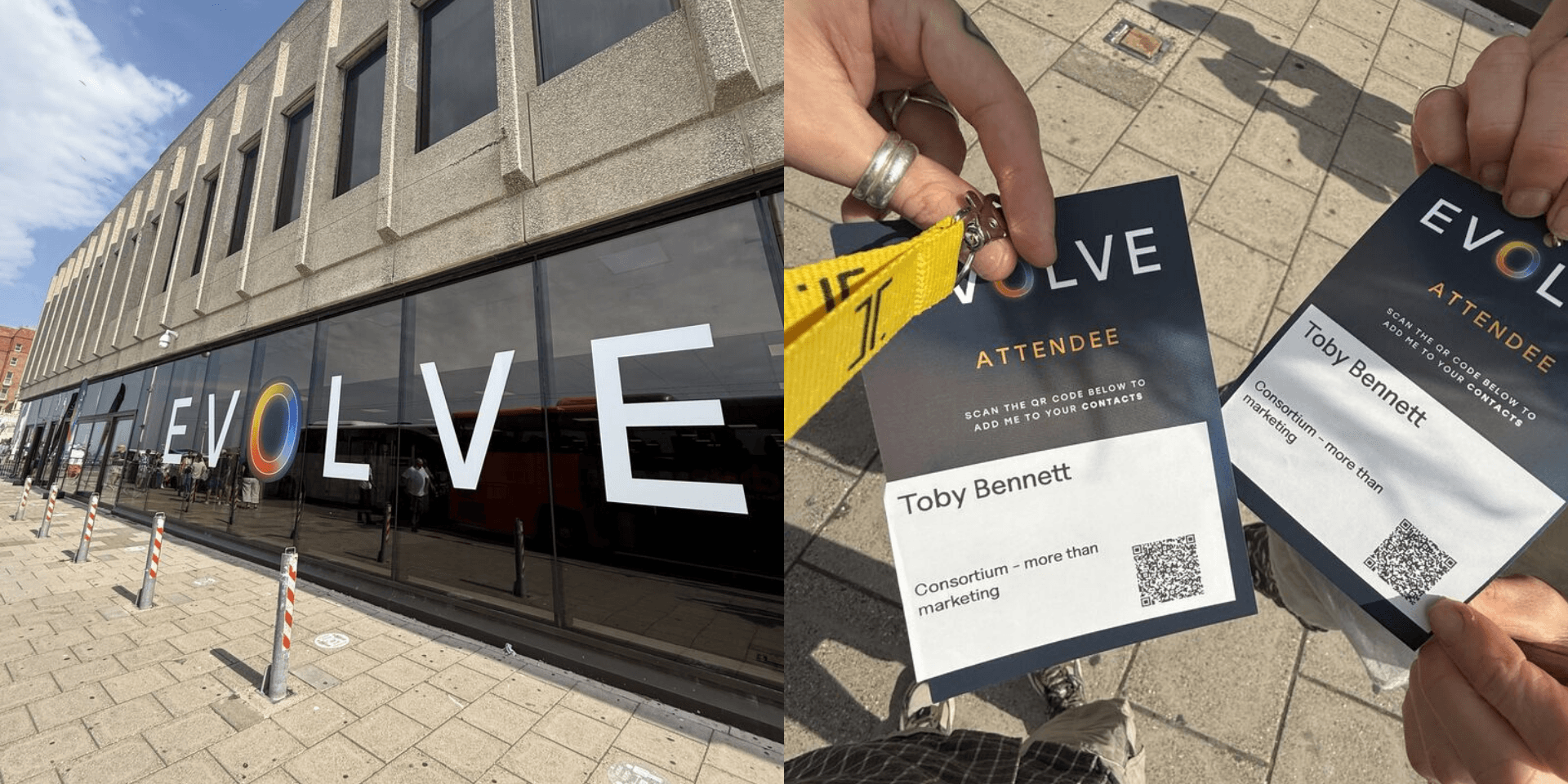
In June, Laura Hearn (our Brand & Content Manager) and I spent the day at the EVOLVE 26 Conference at the Brighton Centre. I went along with a fairly clear agenda: to get a better handle on how we can use AI well, and to understand more about where Google search is heading, because that landscape is shifting under everyone’s feet right now.
I came away with a head full of ideas, a few new tools to play with, and, somewhat unexpectedly, one question I haven’t been able to shake since…
That question came from a session on the Pioneers Stage: “From Threat to Advantage: The AI Pivot”, with James Chadburn, Managing Partner at Dean Wilson LLP, and Geoff Davies, CEO of Dovetail. If James’s name sounds familiar, it might be because he joined us on our more than marketing podcast earlier this year, and we’ve worked with Dean Wilson on their marketing activity before, so I already knew this was a firm doing things differently.
What Dean Wilson are doing is genuinely quite revolutionary for a traditional law firm. This isn’t a firm bolting a chatbot onto the website and calling it innovation. They’re testing everything properly, taking their time, and embedding AI as a real capability across the business rather than a gimmick. No AI theatre, no doom-mongering (a new word of mine), just a leadership team that decided to stop watching from the side lines and start building the next generation law firm, and it was clear from the talk that this isn’t something they’re doing to their people, but with them.
The legal ladder problem…
Think about how lawyers have always learned. A legal assistant reports to an associate, the associate reports to a senior associate, the senior associate reports to a partner and so forth, who has the overall insight and carries the ultimate responsibility. Knowledge trickles down, and experience is earned on the way up, largely through the unglamorous stuff: the document reviews, the first drafts, the research tasks, the admin-heavy work not everyone enjoys!
Now picture where the whole profession is heading, with AI doing that initial heavy lifting. The first draft is generated, the research is summarised, the admin is automated… on paper, brilliant! Junior lawyers freed from the ‘grunt’ work to do more meaningful things.
If AI takes on the tasks juniors traditionally do, how does the next generation develop the expertise that current partners have now? Who trains the trainees when the training work is automated? If a junior lawyer never writes a hundred imperfect first drafts, do they ever develop the eye to spot the flaws in an AI-generated one? And in twenty years’ time, when today’s partners have retired, who’s left with the depth of experience to hold the whole thing together?
I don’t think anyone has a complete answer yet, and I’d be suspicious of anyone claiming they do! This isn’t a criticism of firms implementing AI. If anything, it’s the opposite. It’s the firms testing carefully and thinking hard about how AI fits around their people who are most likely to crack this. The question lands on every firm regardless, whether they’re embracing AI or ignoring it…
What juniors can do about it
Here’s where I land on it, though. If part of the traditional learning route is being reshaped, the next generation of lawyers has both a challenge and a genuine opportunity: the space to build the skills that AI can’t replicate, earlier in their careers than any generation before them.
Business development is the obvious one. Relationships, networking, being visible in your local business community, building a name people trust. Historically, most lawyers didn’t really start on this until they were senior but there’s no reason a trainee can’t start now.
The same goes for personal profile. Writing, speaking, sharing a point of view, building genuine thought leadership rather than waiting for seniority to grant you the permission. Clients increasingly choose people, not just firms, and the lawyers who understand that early will stand out.
And underneath all of it sits the skill that I think matters most: being human. Empathy, judgement, communication, the ability to sit across from a client on the worst day of their life and make them feel understood and no model does (or I hope will never do!) that.
A balancing act
That was actually the biggest theme I took from EVOLVE as a whole, and it’s one we’re focusing on at Consortium this quarter: the balance between artificial intelligence and human intelligence. The firms that get this right won’t be the ones that resist AI, or the ones that hand everything over to it. They’ll be the ones that use it to amplify their people while doubling down on the human side of legal practice.
The technology is coming either way…. the question is what kind of lawyers we build alongside it?
If you’re a junior lawyer, or a firm thinking about how your next generation develops those wider skills, that’s exactly what our BD Academy was built for. We’ve also published some useful tips on how to build your profile and authority on LinkedIn as a lawyer.