


Exhibiting works for legal sector suppliers when three things are in place: a specific objective agreed before you book, a stand staffed by people who can hold a proper conversation, and a follow-up plan that starts the morning after. Most of the return is decided before the doors open and after they close, not on the day itself!
Exhibiting at industry events provides a unique opportunity to showcase your brand, engage potential clients, and network with industry peers. However, simply showing up isn’t enough! To truly capitalise on these events, you need a well-thought-out strategy.
In this blog, our events team, who help legal sector suppliers get the most from the rest of the events calendar, share some practical tips and best-practice reminders on how to make the most of exhibiting at events:
Why exhibit?
Events have grown massively. The Events Industry Alliance counted 1,154 exhibitions at the UK’s main venues in 2025, the highest number since 2015, attracting 6.8 million visits. And there are thousands more smaller conferences and seminars in hotels and members’ clubs. It feels that there is an abundance of legal sector events taking place every week – covering everything from leadership and legal tech, through to wellbeing and regulatory changes!
Exhibitions offer excellent opportunities to:
- Generate quality leads – Meet people already interested in your sector.
- Boost brand awareness – Get your name out there.
- Network – Not only with attendees but with other exhibitors, speakers and industry leaders.
- Achieve measurable results – When approached correctly, events can provide clear returns on investment.
Marketers agree on this too. In Bizzabo’s 2026 State of Events research, 78% of organisers rated in-person events as their most impactful channel, yet 40% still struggle to prove the return, and the difference is almost always whether measurement was designed in at the start. If you sell to law firms it is also worth understanding the events they run themselves; our guide to event ideas for law firms shows what your prospects are busy organising, and sponsoring one of those is sometimes cheaper than a stand of your own.
Setting your strategy
Every single piece of marketing activity you do should complement your overall strategy. Whether it’s an email, a social media post, or indeed taking an exhibition stand at an event. If that strategy is not written down, start with a marketing audit before you commit to a stand. A single exhibition can cost more than the rest of the year’s marketing put together, which makes the decision to book worth a proper look.
Before committing to an event, clearly define your goals. Ask yourself:
- Why are you exhibiting?
- What does success look like?
- How will you measure success?
For example, rather than vaguely aiming to “raise brand awareness,” be specific. A better goal would be: “Speak to 50 key contacts, add 25 new mailing list subscribers, and gain 10 new social media followers within a week.” Then add a commercial number alongside it: two qualified demos booked, or one proposal requested. Vanity metrics keep marketing busy; qualified conversations keep it funded.
Is this the right event? Questions to ask before you book
Not every event deserves a stand. Before you sign the exhibitor contract, check:
- Who actually attends – Ask the organiser for last year’s attendee breakdown by job title and firm size. Practice managers and partners buy; trainees browse.
- Who else exhibits – Your competitors’ presence tells you the buyers are there. Their absence tells you something too.
- What is the cost per conversation – Total cost (stand, build, travel, staff time, giveaways) divided by a realistic number of quality conversations. Compare it with a sponsored webinar or a breakfast briefing of your own.
- Is there a speaking or sponsorship option – A 20-minute slot on the programme often outperforms a stand, and can be cheaper.
- Does the date clash – With your own clients’ busiest periods, or with the other event your prospects will choose instead.
Pre-event planning
Good planning is the backbone of event success. Remember the famous quote by Benjamin Franklin: “If you fail to plan, you plan to fail!” Here’s how to start:
- Set SMART objectives or OKRs (Objectives and Key Results).
- Know your audience – Tailor your messaging and approach accordingly.
- Engage early – Use social media to build awareness of your presence. Post that you are attending, tag the organiser, and book meetings in advance through LinkedIn; our free LinkedIn guide covers how to do that without sounding salesy. Schedule the posts so they go out while you are on the road; we compare the tools in our pros and cons of social media scheduling.
Consider any additional sponsorship or speaking opportunities to enhance visibility. Speak with event organisers for a list of attendees and exhibitors to strategically plan your outreach. Sponsorship deserves a calculation of its own; our article on sponsorship as a marketing tool explains when it pays.
Designing an attention-grabbing stand
Your stand should draw people in and communicate what you do instantly. If you are lucky enough to have a large marketing budget to blow on a fancy exhibition set up, then great! But there’s also nothing wrong with a simple pop-up banner, as long as you have a strategic plan of action and a great team staffing your stand. Focus on:
- Clear messaging – Make sure it’s obvious who you are and what you offer. Lead with the problem you solve for a law firm, not your product name.
- Longevity & mobility – Invest in a stand that is durable and easy to transport.
- Interactive elements – Use QR codes, downloads, or demos to engage passers-by. Physical brochures and business cards are still effective but consider offering digital alternatives too. A 90-second explainer video on loop does more than a wall of copy.
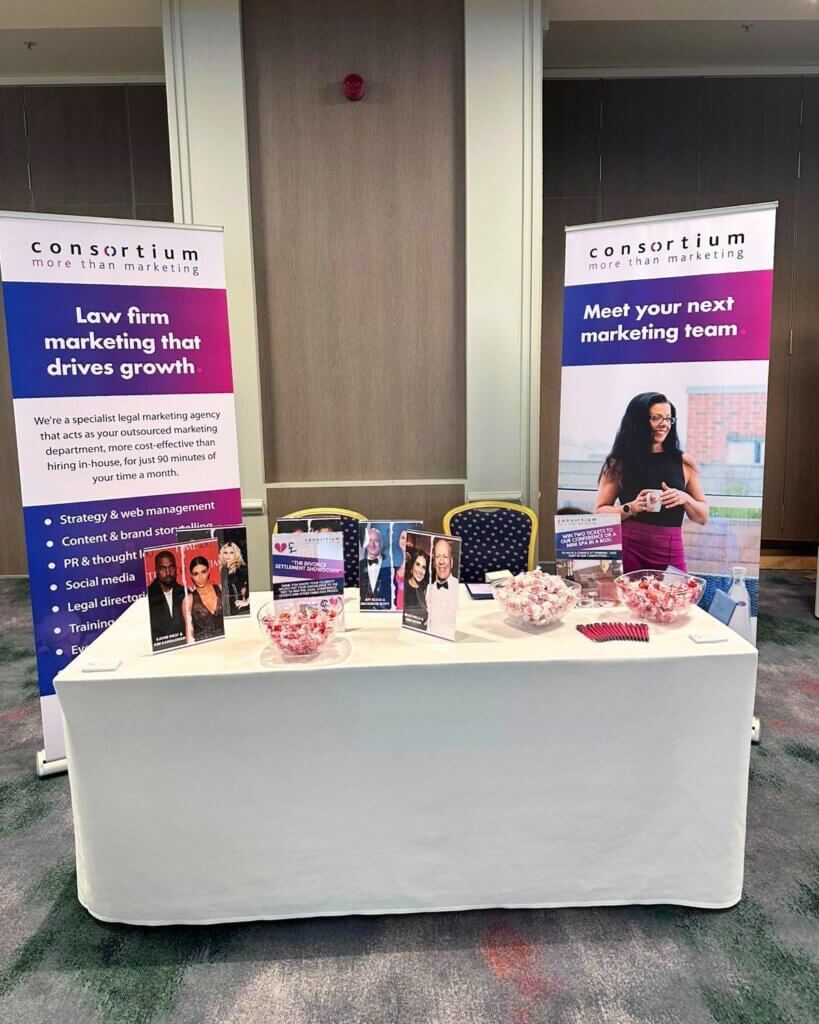
Here’s an example of one of our stand from the 2026 Resolution Family Law Conference:
Choosing the right giveaways
Freebies can help draw visitors to your stand, but they should reflect your brand values and resonate with your target audience. When planning giveaways, consider:
- Environmental impact – Eco-friendly items are increasingly appreciated.
- Brand alignment – Choose items that match your company values.
- Quality over quantity – A thoughtfully selected, higher-quality item will make a better impression than cheaper, mass-produced items. Ask whether it will still be on a desk in a law firm in three months; a good notebook is, a stress ball is not.
Engaging visitors and collecting data
One of your main objectives at any event should be data collection. Here are some ideas to maximise data capture:
- Use technology – Conference apps, scannable codes, and simple sign-up forms can make this easier. Make sure the form asks for marketing consent, so the contact can go straight into your email nurture sequence rather than sitting in a spreadsheet.
- Create an experience – Offer games, competitions, surveys, or polls to engage visitors and collect their data at the same time.
- Special offers – Entice attendees to sign up for free trials, demos or exclusive discounts.
- Let your clients do the talking – If an existing customer stops by, ask for a quote, a photo or a review there and then. A client telling a prospect “we use them” at your stand is worth more than any brochure.
Running competitions
Competitions at exhibition stands can be a crowd-puller, but they need to be creative. Go beyond basic ‘business card in a bowl’ type raffle and think of ways to align the prize with your company’s mission or values.
Getting attendees to linger on your stand for a while whilst completing a challenge or game, can give you more time to speak with them and expose them to your branding, messaging and key people. One caveat for this sector: keep prizes modest. Law firms have gifts and hospitality policies, and a prize that looks like an inducement can cost you the relationship you were trying to start.
Your dream team
The people representing your company at the event are your greatest asset. Especially in the professional services sector, where people very much buy into people rather than brands. Ensure your team:
- Understand the objectives – Everyone should know what success looks like. Brief them on the three questions you want every visitor asked, and what to do with the answers.
- Has the right motivation and personality fit – They need to engage visitors confidently and naturally.
- Dresses the part – Have a clear dress code that aligns with your brand, and ensure all staff are identifiable.
On the day: practical tips
Here are a few essential tips to keep in mind during the event:
- Be prepared – Have everything you need to hand, from marketing materials to business cards.
- Capture the moment – Take photos and videos for post-event marketing. Post some of it in real time too; a busy stand or a speaker takeaway reminds people who have not visited yet to come and find you.
- Engage with other exhibitors – They may become future clients or partners.
- Stay approachable – Keep personal items hidden and stay open to conversation. Stand in front of the table, not behind it, and put the phone away.
- Ask open questions – This encourages engagement and more meaningful conversations with attendees.
Post-event follow-up
Don’t let the momentum of the event stop at the end of the day. Effective follow-up is crucial for success:
- Update your CRM – Ensure all data collected is promptly added to your system, with the event name recorded as the source so you can trace what it produced later.
- Personalise your follow-ups – Whether it’s a call or email, make sure each follow-up feels tailored to the individual. Recall the conversations you had and make your approach relatable. Do it within 48 hours, while they still remember you.
- Create a follow-up campaign – Use the event as a launchpad for future marketing efforts. It doesn’t stop once you have packed everything away! A short email sequence planned before the event, with the first message written and ready to send the morning after, is the single biggest difference between exhibitors who see a return and those who do not.
- Debrief with your team – Evaluate what went well and where improvements can be made.
A simple follow-up timeline
- Day 1 – Thank-you email to everyone you scanned, with whatever you promised them on the stand.
- Days 2 to 3 – Personal messages to the warm conversations, and LinkedIn connection requests with a line about what you discussed.
- Week 1 – Demos and meetings booked; CRM updated; one piece of content from the day (photos, a takeaways article, a short video) published and shared.
- Weeks 2 to 4 – Nurture emails to everyone else, and a second touch for the warm list.
- Month 3 – Review the pipeline attributed to the event and decide whether to rebook while the early-bird rate still applies.
How do you measure exhibition ROI?
Marketing is notoriously difficult to measure. Sometimes you just get a ‘feeling’ that an event has gone well or that your stand felt busy. But did it generate results? Here is where your strategy and SMART objectives that you set before the exhibition come into action. Measure up against what you set out to achieve.
Most exhibitions come with significant costs, so it’s crucial to measure return on investment in any way that you can. Think beyond just gaining new business or appointment – brand exposure, networking, website traffic, social media followers, downloads, email sign ups and data collection are valuable metrics too. Where the numbers exist, use them: cost per lead, cost per meeting and, six months on, revenue attributed to the event against everything else you did that quarter. If an event generated nothing measurable, that is a result as well; our article on busy vs effective marketing explains why unaudited activity is the most expensive kind.
The suppliers we work with treat events as one line in the plan rather than the plan. Xperate, a legal technology firm, uses an event framework to decide which conferences to attend and what each has to deliver; DevAssist weighs event sponsorships against email and social media in the same way. Both measure consistently, which is what makes comparison possible.
In conclusion
Exhibiting at an event is a powerful way to boost your business, but only if you approach it strategically. From planning and designing your stand to engaging visitors and following up afterward, each step plays a vital role in maximising the opportunity.
Remember: The event doesn’t end when the doors close – it’s the starting point for building lasting relationships.
Frequently asked questions
Is exhibiting worth it for legal sector suppliers?
Yes, when the audience matches your buyers and you follow up. In Bizzabo’s 2026 research 78% of organisers rated in-person events as their most impactful channel, but 40% could not prove the return. The difference is measurement, not the event.
How much does it cost to exhibit at a legal sector event?
Stand fees range from a few hundred pounds for a table at a regional event to five figures for a large stand at a national conference. The stand is usually less than half the true cost once build, travel, staff time and giveaways are added, so budget on the total.
How do you attract people to an exhibition stand?
Pre-booked meetings, a reason to visit (a demo, a competition, a piece of research), staff who stand in front of the table rather than behind it, and posts during the day that tell people where to find you.
How quickly should you follow up after an exhibition?
Within 48 hours for the warm conversations and within a week for everyone else. Write the first email before the event so it can go the morning after.
What should suppliers give away at legal events?
Something useful, well made and on-brand, or nothing at all. Keep competition prizes modest, because most law firms have gifts and hospitality policies and an expensive prize can look like an inducement.
Let us take the burden off you
We support legal sector suppliers with marketing strategy and hands-on delivery, including choosing the right events, pre-event campaigns, stand messaging, social media on the day and the follow-up that turns conversations into pipeline. If you would like the exhibition to be one line in a plan rather than the whole plan, our marketing management service runs it month to month.
Call 01903 530 787 or submit an enquiry via our contact form and a member of our team will be in touch shortly.